The Corner That Gives a Circuit Its Character
Learn to read circuit character from a track map by tracing how bends, straights, and direction changes shape its visual rhythm.
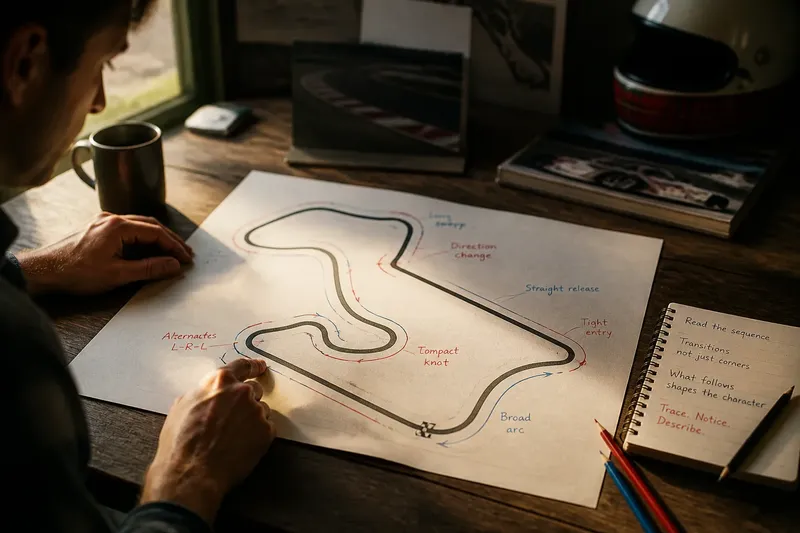
A circuit map reveals its character most clearly where one corner changes what the next section can look like. To read circuit character, follow the line of bends, straights, and direction changes as a connected sequence, not as a collection of isolated turns. The useful question is not which corner looks most dramatic, but what the track asks your eye to do immediately afterward.
That approach also helps when a map seems confusing, generic, or misleadingly simple. A long straight can make a circuit look plain; a compact knot of bends can make it seem complicated without explaining its rhythm. In each case, the remedy is to trace the route in order and notice how one shape hands the drawing to the next.
Why does the map look like a string of unrelated corners?
The usual cause is reading each bend as a separate icon. A hairpin, a chicane, and a sweeping curve are easy to name, but names alone do not show whether the sequence tightens, opens, doubles back, or changes direction repeatedly.
Start at a clear point on the map, such as the main straight, and trace the circuit with a finger. At every bend, ask what follows: a long straight, another bend in the same direction, or a quick reversal? This turns a list of corner shapes into a visual sentence. A bend that leads into open space reads differently from the same bend followed by a tight change of direction.
Pay attention to the gaps between the lines as well as the curves themselves. A broad interval can make a turn feel like a pause before the next cluster; a short interval can make two bends read as one linked gesture. The map is a little like a handwritten signature: its character often sits in the joins, not in any single stroke.
What if a long straight seems to erase the circuit’s personality?
A straight can appear to be blank space between the interesting parts. That impression often comes from treating distance on the page as a break in the sequence. Instead, look at how the straight begins and ends. Does it emerge from a tight corner, a broad arc, or a change of direction? What sort of shape closes it?
Those connections give the straight a role in the drawing. A corner that points the route toward an extended straight creates a clear release in the visual rhythm. A straight that runs into a compact bend brings the eye to a sudden stop. The intervening line may be simple, but its relationship to its neighbors is not.
If the map is hard to follow, mark the entry and exit of the straight with two small pencil dots. Trace the route between them, then inspect the preceding and following turns together. Avoid inferring speed, passing opportunities, or vehicle behavior from the drawing; those depend on details a simplified map may not show.
Why do several bends blur into one busy knot?
Closely grouped turns can look like clutter, especially when the map uses a thick line or omits corner labels. The cause is usually a shortage of visual landmarks: the eye has no obvious place to pause before the direction changes again.
Look for the broad pattern before trying to name individual corners. Does the route weave from side to side, curl around a compact area, or make a sequence of changes that gradually opens outward? Then follow one bend at a time and note where the path crosses, nearly meets, or runs beside another section. These relationships can explain the knot without requiring a precise scale.
Imagine a fan tracing an unfamiliar circuit on a folded program map. They first mistake three neighboring bends for one tangled loop. Starting at the straight nearest the map’s edge and tracing toward the cluster, they notice that the route alternates direction before opening into a broad arc. The expected result is a clearer mental picture of the sequence, not a claim about how a car would handle it.
How can you spot direction changes that shape the whole layout?
Look for reversals and repeated alternation. A route that bends left, then right, then left again gives the map a visibly different rhythm from one that keeps curving broadly in a single direction. The distinction can be easy to miss when a circuit diagram is rotated or printed without a north arrow; map orientation does not change the sequence, but it can make the drawing feel unfamiliar.
One simple method is to write a small direction note beside each bend: left, right, or broad arc if the map does not make a sharper turn clear. This is a reading aid, not a formal classification. If a bend’s direction is ambiguous at the available scale, leave it uncertain rather than forcing a label.
Next, group neighboring turns by whether the route continues or reverses its movement. A quick alternation suggests a different visual pulse from a sustained curve followed by one decisive turn. The point is not to score the layout, but to see where the eye is repeatedly redirected and where it can follow a longer sweep.
What should you check when a circuit map remains hard to read?
Does the map show the route in sequence?
Find the start-finish line, arrows, or corner numbers and establish which way the route runs. If those markers are missing, trace both possible directions before deciding that a section is disconnected.
Is the drawing simplified or distorted?
A program diagram may compress a long straight or widen a tight cluster to fit the page. Treat the picture as a guide to the sequence of shapes, not as a survey drawing with dependable scale.
Are nearby sections crossing or merely passing close together?
Check for a bridge symbol, gap, or clear change in line style before assuming that two parts of the route intersect. If the map provides no clue, note the uncertainty rather than inventing a connection.
Which neighboring shapes make the confusing part easier to place?
Follow the route from a recognizable straight or broad bend into the unclear area, then continue until another distinctive shape appears. The approach and exit often identify the sequence more reliably than the crowded middle.
How do you turn a map into a clear visual description?
Once the sequence makes sense, describe what the route does rather than reaching for a grand label. You might call it a long sweep into a reversal, a straight broken by a close pair of turns, or a compact weave that releases into a broader arc. Such wording tells a reader what to look for on the page and keeps the account tied to visible evidence.
For circuit character, the most useful habit is to return to the transition after every named corner: what direction does the route take, how quickly does it change, and what shape follows? That habit makes maps easier to compare without pretending that their drawings reveal every detail. When a diagram leaves a gap in the story, say what remains unclear; an honest blank is less confusing than a confident guess.