The Pit Board as a Message in Motion
The pit board turns race information into a glanceable signal, showing how a few bold marks communicate across speed, distance, noise and changing light.
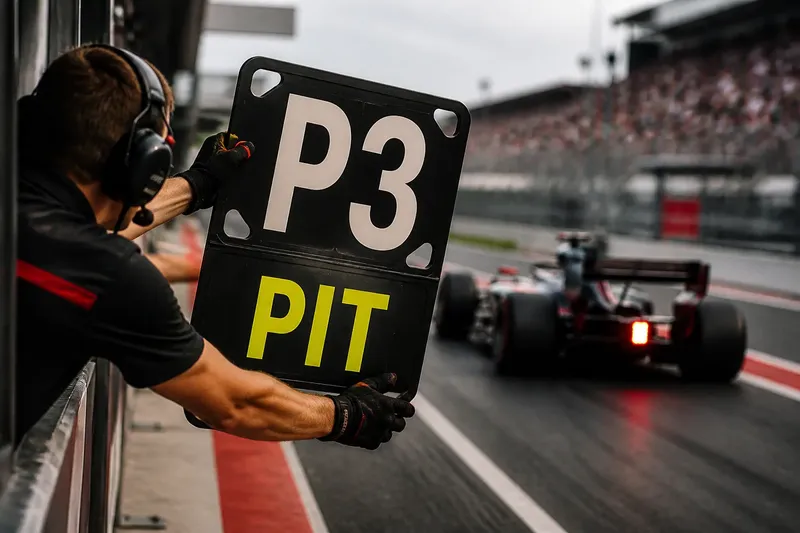
A pit board makes race information legible at speed by stripping it down to a few bold marks. Its message has to cross a strip of asphalt, a driver’s focused field of view and the noise of a working circuit, then make sense before the car is gone. That constraint gives the pit board its distinctive visual language: part instruction, part landmark, and part public emblem of the team.
What does a pit board need to communicate?
At its simplest, a pit board tells a driver something useful about the race. Depending on the series and the team’s conventions, it may show a car’s position, a gap to another competitor, a lap count, a message from the crew or a request to come into the pits. The board is not a small dashboard held outside. It is a brief, external signal intended to be read while the driver is managing the car.
That distinction shapes the design. A driver cannot stop to study a sentence, compare small labels or wonder whether a mark refers to the car ahead or behind. The board must present the important information first, using a compact arrangement that the driver can recognize quickly. Teams often establish a consistent layout so that the meaning of each area becomes familiar through use.
Numbers tend to do the heavy lifting. A large numeral can state a position or identify a car; a second value can express a gap or another piece of race context. A short word or abbreviation may carry a direct instruction. What belongs on the board depends on the race, the driver and the team’s communication system, but the underlying question is always practical: what can the driver act on during this pass?
Why does the board have to work at a glance?
The driver sees the board for a limited moment, often while approaching a familiar location at speed. Peripheral vision, the car’s motion and the surrounding traffic compete for attention. A readable board therefore relies on hierarchy: the most important mark should dominate, while supporting details remain distinct rather than crowded together.
Bold contrast helps separate a symbol from its background. Large characters are easier to distinguish than fine lettering, and clear spacing helps keep adjacent items from running together. A board crowded with every available detail can be less informative than one carrying only the message the driver needs. The aim is not visual richness. It is recognition without hesitation.
Think of a pit board as a road sign seen through a windshield: its shape and main mark should register before a reader could parse a paragraph. The comparison is limited, since a race message can change from one pass to the next, but it explains why restrained layouts matter. The board’s visual language favors strong silhouettes, simple grouping and few competing colors.
How does a message become a signal?
The meaning of a board comes from more than its lettering. Positioning, timing and repetition all help the driver identify it as a message from the team. Crew members present the board at the team’s designated place, where the driver expects to see it. If the display arrives too early, too late or among unrelated visual clutter, the same clear marks may be harder to use.
The crew member holding it is part of the communication system. The board must be visible, held steadily and presented in a way that makes its face readable to the approaching driver. The person is not merely displaying a graphic; they are placing a signal into the driver’s view at a useful moment. That practical role is one reason the pit wall can look choreographed even when the message itself is spare.
Imagine a team whose board has one large position numeral and a separate space for a short instruction. If the crew changes the instruction from a neutral reminder to “PIT,” the driver can recognize the familiar layout and notice that the secondary field has changed. The expected observable result is a clear distinction between the standing information and the new call, without asking the driver to decode an entirely different design.
What do color and layout tell the driver?
Color can help separate functions, but it cannot carry the whole message. Lighting, distance, weather and a driver’s viewing angle can all change how a hue appears. Strong contrast between the character and its field is generally more dependable than subtle shades that look distinct in a workshop but merge at the circuit. Teams also have to consider whether a mark remains recognizable when seen briefly rather than studied at close range.
Layout supplies another layer of meaning. A stable division between a primary number and a secondary message lets the driver know where to look. Consistent alignment helps the eye compare one display with the next, while a sudden change in a familiar location can make new information stand out. This is not a matter of decorating a board until it looks balanced; the arrangement should support the way the message is read.
Letters and abbreviations need the same discipline. A shortened term saves space only if the driver already understands it. An unfamiliar abbreviation is not compact communication; it is a puzzle with a moving deadline. The team’s conventions matter because the board has no room to explain itself.
Which pit-board questions do fans ask?
Are pit boards still used when teams have radio communication?
Yes, a board can provide a visible backup or a direct visual cue alongside radio communication. Its value depends on the series, the team’s procedures and what the driver needs to see at that moment.
What do the numbers on a pit board mean?
They may indicate position, a gap, a lap count or another item defined by the team. The arrangement and the team’s established conventions are needed to interpret a particular board accurately.
Why do pit boards use large lettering?
Large lettering is easier to recognize during a brief pass than fine text. Clear spacing and strong contrast also help keep marks distinct as the viewing angle and light change.
Can a fan read every pit board from the grandstand?
Not necessarily. Boards are intended primarily for the driver, and a spectator’s angle, distance or obstructed view may make their details difficult to distinguish.
How did a working tool become part of racing’s visual culture?
The pit board is functional, but its form is also unusually easy to recognize. A small rectangle, a few high-contrast fields and large characters can stand out in a crowded pit lane. Fans see the boards from grandstands, television cameras and trackside photographs, often beside crew members leaning toward the circuit. The object makes a team’s act of communication visible, even when the actual information is too small or too fleeting for spectators to read.
That visibility gives the board a place in racing imagery. It appears in photographs as a frame between the pit wall and the car: the crew holds the message, the driver passes, and the board becomes a marker of the exchange. Its graphic simplicity also makes it legible as a motif on team materials and fan-made art. The board’s cultural character comes not from elaborate ornament but from the unmistakable job it performs.
Different teams can make the object their own through color, typography and arrangement, while retaining the same basic logic. A board that echoes a team’s visual identity can be recognized as belonging to that group; its practical fields still need to remain distinct. Branding works best as a supporting layer, not as a substitute for readable information.
What does the pit board reveal about racing?
The pit board shows how racing communication is shaped by time and attention. It turns a complex situation into a sign that can be recognized during a short encounter, and it makes an otherwise invisible exchange visible to everyone watching. The board is both a tool for the driver and a small piece of theater at the circuit, though its theatrical quality follows from its use rather than from any need to perform.
Its clearest lesson is modest: a message becomes useful when its form suits the conditions under which someone must read it. In the pit lane, that means fewer marks, stronger hierarchy and a familiar arrangement. The next time a board appears in a race photograph, look first at what dominates its face, then at where the crew member is holding it. Those details show how the object is designed to speak before the car has passed.