Why a Grandstand View Never Shows the Whole Race
Why a grandstand view never shows the whole race: learn what your seat reveals, what it hides, and how to enjoy the distinct atmosphere around it.
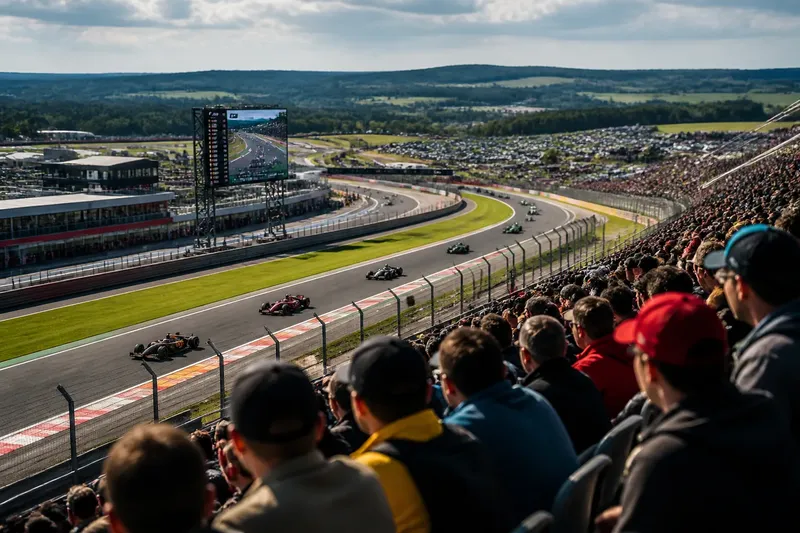
A grandstand view never shows the whole race, and that is not a defect in the seat. From one place, you can follow certain cars, gestures, and changes with unusual clarity; the rest arrives as engine note, crowd reaction, or a gap in your view. Treating the seat as a particular instrument makes the day richer than demanding that it behave like a television director.
What does your seat let you read?
Every grandstand has a visual vocabulary. A seat near the start-finish line makes the grid, launch, pit exit, and flag easy to follow. A stand facing a braking zone may show cars arriving in a compressed line, then separating as drivers choose their path. From a high stand, the field can look orderly; lower down, barriers and fencing may turn each passing car into a brief appearance.
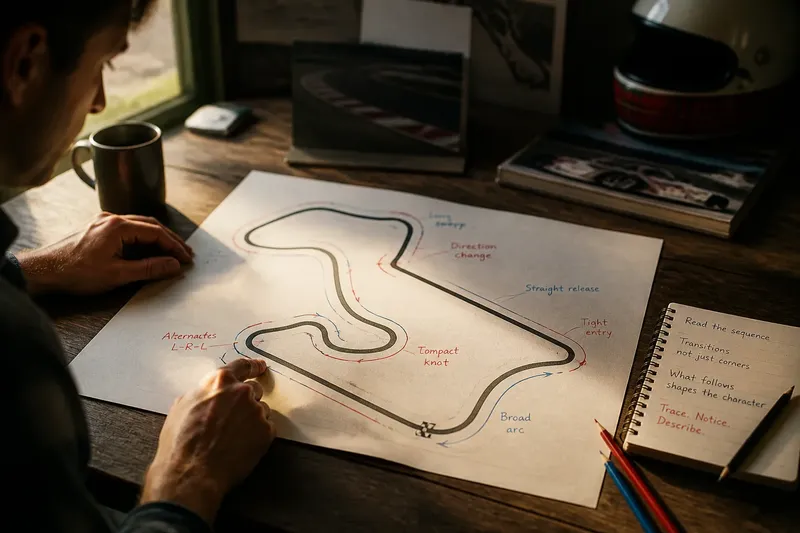
Before settling in, look across the circuit and identify the visible landmarks: a marshal post, a bridge, a timing screen, the edge of a pit building. These give you reference points when the cars are distant. If the circuit map marks named corners, check whether the stand actually faces the feature you want to watch. A label on a map can cover more ground than your eyes can.
One ordinary analogy helps: a grandstand is like a window in a room. The view may be excellent, but the frame still decides what enters it. The useful question is not whether the window contains everything; it is what becomes legible through it.
What disappears beyond the frame?
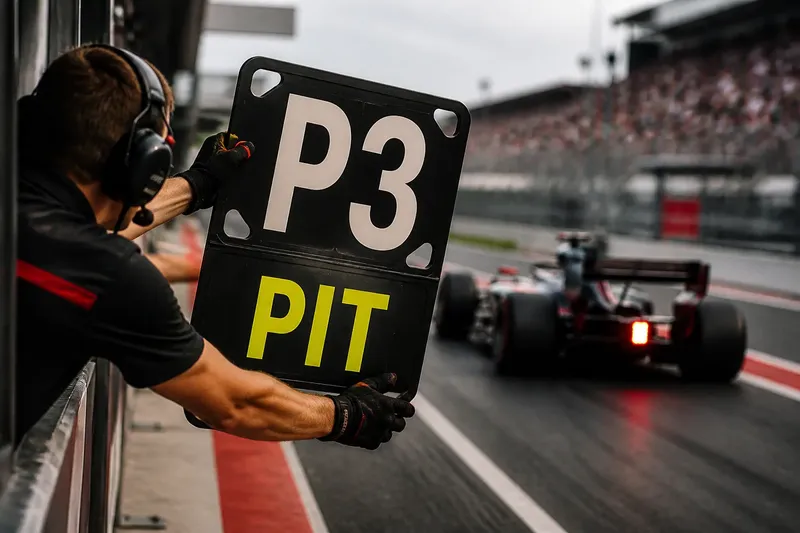
A race unfolds across a circuit, while a spectator occupies one small patch of ground. A car may leave your sight before the next corner, and a pass completed out of view may become apparent only when the order changes on a screen. Pit strategy, radio exchanges, and incidents on the far side are likewise partial or absent from the grandstand’s account.
Even the visible action can mislead if you expect a single angle to explain it. A car that appears to lose ground may be saving space, responding to traffic, or simply passing through a section where the stand offers a poor sightline. The view records what happens in front of you, not every reason behind it. A timing display can supply useful context, but it cannot restore the missing perspective.
It helps to distinguish watching from knowing. You can watch a car brake, turn, and accelerate; you may not know what the driver is managing at that moment. That uncertainty is part of live spectatorship, not a puzzle that must be solved before the next lap arrives.
How can you make one patch of track feel complete?
Choose a small set of things to notice rather than trying to track every car. Pick a color, a number, or a pair of competitors, then watch how they behave through the section you can see. Notice where the field bunches, which cars leave room, and how the sound changes as the pack approaches and recedes. A repeated view can reveal patterns that a quick glance across the whole circuit would miss.
Say you are seated above a corner exit, with a screen visible but no view of the preceding turn. You decide to follow two cars with distinctive liveries and watch how cleanly each gets onto the straight. The observable result is a small, coherent story: one car arrives close, the other leaves a wider gap, and the timing screen helps you connect that moment to the next pass. You still do not see the whole race, but you have something specific to follow.
Keep the screen in the role of a caption, not a replacement for the circuit. Glancing down after a burst of action can tell you whether the order changed. Watching the screen continuously tends to exchange a distinctive live view for a smaller version of a broadcast you did not travel to see.
What does a grandstand sound like?
Atmosphere has its own sightline. A stand near the start may respond to the launch as one body; another may stir when a favorite car appears from behind a barrier. The crowd’s attention can travel faster than a car in your field of view. A sudden rise in noise often tells you that something has happened elsewhere, though it does not tell you exactly what.
Listen for the differences between the cars as they pass. Engines do not arrive as a uniform wall of sound: distance, speed, barriers, and the shape of the stand alter what reaches you. The gap after a group passes can be as telling as the rush itself. It gives the next cluster room to announce itself.
Small local details matter, too. The view may include a marshal signaling, a flag moving above the fence, or spectators leaning forward before the cars appear. Those cues make the stand feel like a place in the event rather than a viewing platform detached from it.
What should you look for before choosing a stand?
When comparing grandstand seats, think in terms of the kind of attention you want to spend. A long straight favors speed and passing opportunities; a corner may favor visible changes of line; a start-finish area offers ceremony and repeated references to the running order. None provides a neutral, complete account, so choose the view whose partial account interests you.
- Check the sightline: Look for fencing, support poles, signs, and structures that may interrupt the view.
- Check what lies beyond the main action: A visible screen or neighboring section can add context, even if it cannot show every incident.
- Consider the approach: A seat reached through a crowded or exposed route may shape how comfortable it is to arrive and leave.
- Notice the direction of the sun: A screen can be difficult to read in glare, while shade may matter during a long session.
- Decide what you want to hear: The acoustic character of a stand can differ from the visual drama, especially near buildings or barriers.
Use the circuit’s seating map and current event information for the practical details. Seat labels, access arrangements, and local rules can vary, so follow the organizer’s instructions where they apply.
Which questions help set expectations?
Can I follow the full race from one grandstand?
No single grandstand gives a continuous view of the entire circuit or all the decisions made during a race. Choose a section you want to understand closely, then use timing information and crowd cues to follow what happens elsewhere.
Is a screen better than watching the track?
A screen can clarify the order and summarize distant events, while the circuit gives you scale, sound, and the timing of cars as they pass. Treat them as complementary sources rather than competing versions of the day.
How do I know whether a seat suits me?
Start with what you most enjoy observing: starts, close running, braking, acceleration, or the crowd’s response. Then inspect the seating map and sightline information for that area instead of choosing only by a corner name.
What if the action happens out of view?
Let the screen, announcer, or crowd reaction fill in what they can, then return your attention to the cars in front of you. Missing a moment does not erase the next one, which will arrive from its own angle.
The best grandstand is not necessarily the one that promises the broadest view. It is the one that gives you a clear reason to keep looking: a particular stretch of track, a change in engine note, or the small wave of anticipation before the field appears. Why a grandstand view never shows the whole race is also why its details can stay with you: they belong to the place where you watched.